


Banks Become the Largest Source of NBFC Borrowings, Surpassing Debentures
Key takeaways
- Banks now lead: bank loans were 39.6% of NBFC borrowings at end-March 2026, ahead of debentures at 34.1%.
- Flip in four years: in March 2022, debentures led by 4.7 percentage points. Banks now lead by 5.5.
- Over half of new money: by our estimate, banks supplied about 52% of FY26's fresh NBFC borrowing.
- Why it happened: lower lending rates, reversed risk weights, and bank loans costing less than debentures for A-rated NBFCs.
- Dependence varies: banks fund 58.2% of microfinance borrowings, while infrastructure debt funds raise 95.3% through debentures.
Banks Become the Largest Source of NBFC Borrowings, Surpassing Debentures
Lenders without a banking licence still run on bank money. In FY26 that dependence crossed a line: banks overtook bonds as the main way Indian NBFCs fund their loan books. Who is funding them, what it costs, and why borrowers should care? This guide answers with RBI data and some fresh calculations.
Are Banks the Largest Source of NBFC Borrowings?
Yes. The Reserve Bank of India (RBI) Bulletin of November 2026 shows bank borrowings were 39.6% of non-banking financial company (NBFC) borrowings at end-March 2026 (FY26): ₹19.43 lakh crore of ₹49.04 lakh crore. Debentures slipped to 34.1%.
| Funding source | Share, March 2022 | Share, March 2026 |
|---|---|---|
| Bank borrowings | 35.3% | 39.6% |
| Debentures | 40.0% | 34.1% |
| Overseas borrowings | 6.9% | 11.0% |
Source: RBI Bulletin, November 2026.
Where Did FY26's New NBFC Money Come From?
The share table hides the flow. Working back from the RBI's growth rates (bank loans +24.6%, debentures +13.2%, commercial paper +21.8%, total +17.9%), we estimate NBFCs raised about ₹7.4 lakh crore of fresh borrowing in FY26:
- Banks: about ₹3.8 lakh crore, roughly 52% of new borrowing.
- Debentures: about ₹1.95 lakh crore, roughly 26%.
- Commercial paper: about ₹0.27 lakh crore, roughly 4%.
- Other sources: the remaining 19% or so.
So banks funded more than half of NBFC growth, well above their 39.6% stock share. These are our estimates from published growth rates, not RBI figures.
An illustration for FY27: if bank loans and total borrowings grow at FY26 rates again, the bank share would reach about 41.9% and debentures would fall to about 32.7%. This is arithmetic, not a forecast.
NBFC Borrowing From Banks: Why the Shift?
The RBI cites lower weighted average lending rates and the reversal of higher risk weights on bank loans to NBFCs. Cost also matters: CareEdge estimates A-rated NBFCs paid roughly 151–204 basis points more on debentures than on bank loans in March 2026. Crisil expects bank funding to rise further in FY27.
NBFC Borrowing Cost in 2026
Cheaper than bonds does not mean cheap. JM Financial noted yields on NBFC borrowings rose about 20–90 basis points after June 2026. Kotak estimates a 50 bps repo hike could add 5–15 bps to funding costs, as 25–50% of NBFC bank loans are repo-linked. More bank funding means rate moves reach NBFCs faster.
NBFC Borrowing Limit: What Do the Rules Say?
There is no single rupee cap. Limits come from:
- Leverage ratio: total outside liabilities divided by owned fund. Upper-layer NBFCs face a leverage requirement.
- Capital adequacy: RBI's directions require capital against risk-weighted assets, at least 15% for middle-layer and above.
- Bank sanction limits: each bank sets its own exposure limits.
Which NBFCs Depend Most on Banks?
Banks supply 58.2% of borrowings at microfinance institutions and 46.6% at investment and credit companies. Debentures supply 51.5% at infrastructure finance companies and 95.3% at infrastructure debt funds. The 39.6% average hides these gaps.
Largest NBFC in India (2026)
It depends on the measure. State-owned Power Finance Corporation tops BankBazaar's AUM ranking. Among private lenders, Bajaj Finance is largest, with AUM near ₹5.1 lakh crore. Muthoot Finance leads gold loans; CreditAccess Grameen leads microfinance.
Why Does the RBI Want Diversified Funding?
Banks lend to households and fund NBFCs serving the same borrowers, so stress can travel both ways. As Business Standard reported, the RBI wants continued monitoring.
Is Your NBFC Safe? What to Check Before Borrowing
Few guides say this, but a lender's funding shapes your experience:
- Funding mix: rating reports from CRISIL, ICRA or CARE list a lender's borrowing profile.
- Rate mismatch: lenders with fixed-rate loans but fast-repricing bank debt, such as microfinance firms, are squeezed first when rates rise.
- Capital and rating: check capital adequacy and the rating outlook.
- Your own contract: an existing loan's agreed terms do not change because the lender's funding tightens. New loans may be slower or costlier.
Frequently Asked Questions
What share of NBFC borrowings comes from banks?
39.6% at end-March 2026, up from 35.3% in March 2022.
What is an NBFC?
A company that lends or invests and is RBI-regulated but holds no banking licence.
Is there a borrowing limit for NBFCs?
No single cap. Leverage, capital adequacy and bank sanction limits apply.
Why is NBFC borrowing cost rising?
Higher bond yields, bank rate resets and possible repo hikes.
Which is the largest NBFC in India?
By AUM, state-owned PFC; among private NBFCs, Bajaj Finance.
Do NBFCs borrow overseas?
Yes: 11% of borrowings in March 2026, against 6.9% in March 2022.
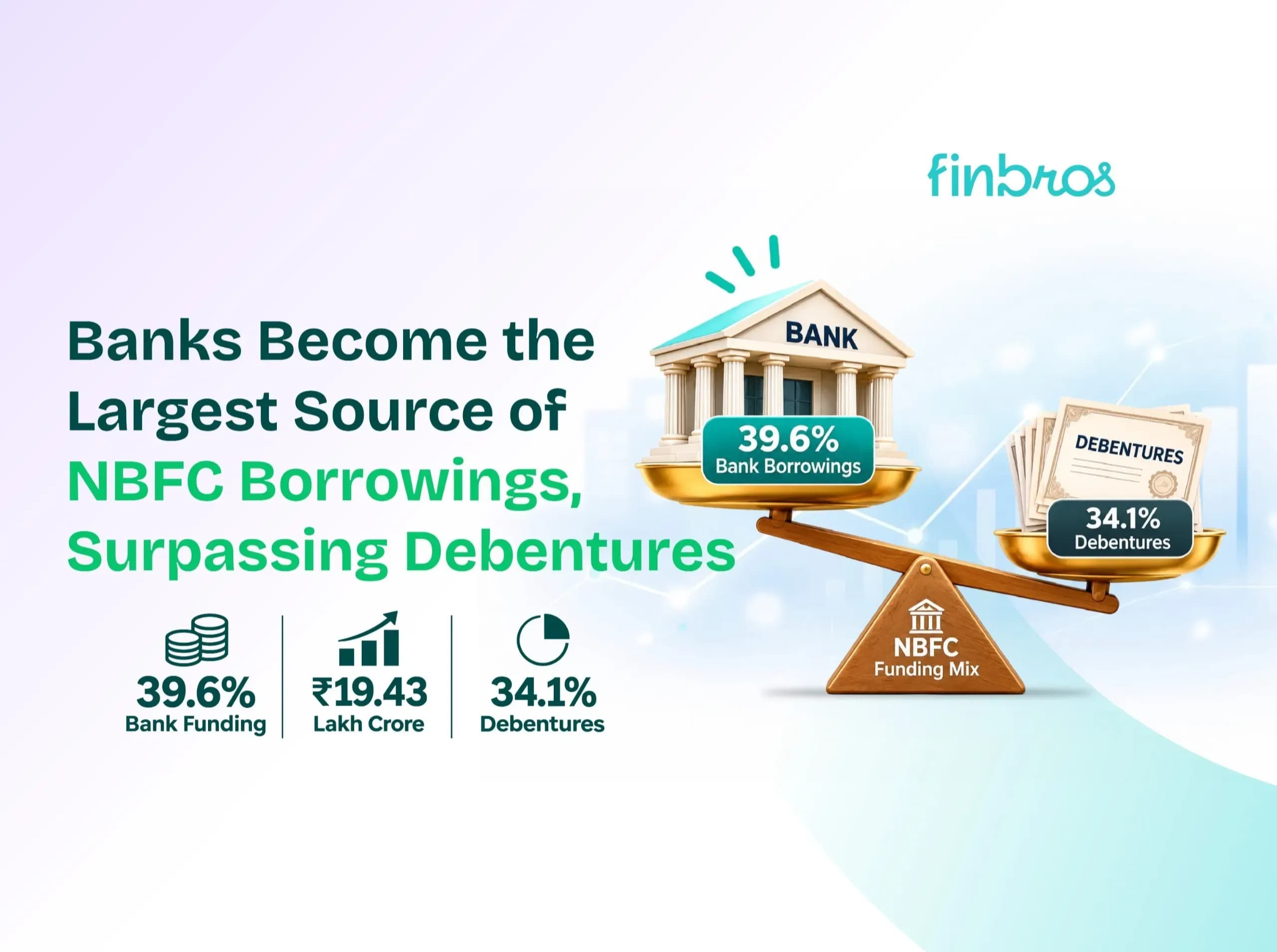
Table of Contents