


How to Combine All Your Debt Into One Payment in India (2026 Guide)
Three credit cards, one small personal loan, and a buy-now-pay-later app you forgot about. Each has its own due date, its own interest rate and its own reminder text. Miss one, and a late fee gets added on top. (This is an everyday example, not a real case.)
If that sounds familiar, you may be asking: how do I combine all my debt into one payment? The usual answer is debt consolidation. It sounds simple, but it isn't right for everyone. This guide explains how it works in India, how much it can save you, how to do it with a low credit score, and what to check before you sign.
Key takeaways
- Debt consolidation means taking one new loan to pay off several debts. You then pay one EMI a month.
- In India, this is usually a personal loan. It works best for unsecured debts like credit card balances.
- Credit cards usually charge about 30% to 48% a year. Personal loans usually charge about 10% to over 20%.
- In our example, moving ₹3 lakh from a 42% card to a 15% loan cut the interest over 36 months from about ₹2.32 lakh to about ₹74,000.
- Compare the total you will repay, not just the EMI. Also check processing fees, GST and prepayment charges.
- You can sometimes consolidate with a low CIBIL score, but you will have fewer lenders and pay higher rates.
- Consolidation pays your debts in full. Debt settlement does not, and it can hurt your credit report.
- Finbros lets you compare offers from 30+ lenders without affecting your credit score. The lender makes the final decision.
What is debt consolidation?
Debt consolidation means taking one new loan and using it to pay off several older debts. Instead of handling four or five payments, you make one EMI a month. You may also see it called loan consolidation or credit consolidation. They all mean the same thing.
It only pays off if the new loan costs less than the debts it replaces, or at least makes repayment easier. If it does neither, skip it. You can read more on our Debt Consolidation Loan page.
How to combine all your debt into one monthly payment: 6 steps
In India, a debt consolidation loan is usually a personal loan. It has no collateral, a fixed repayment period (called the tenure) and a fixed EMI. Here is how to turn many bills into one.
- List everything you owe. Write down each balance, interest rate, minimum payment and due date. Include cards, personal loans and app-based loans.
- Add it up. Find your total debt. Note which debts have the highest rates, because consolidation helps those most.
- Check your credit score and eligibility. Your score affects the rate you get. Check yours with the Free CIBIL Score Check. Then see what you may qualify for with the Eligibility Calculator.
- Compare offers. Find a loan that covers your total debt. Compare the rate, fees, tenure and total repayment. Test the numbers with the EMI Calculator.
- Pay off the old debts. Some lenders send the money to you first. Others pay your creditors directly. Ask which one applies. If the money comes to you, pay off the old debts right away.
- Finish up. Ask each old lender for a closure or no-dues letter. Set up auto-debit for your new EMI. After a few weeks, check your credit report to make sure the old accounts show as closed.
Other ways to combine or reduce your debts
| Method | How it works | Best for | Watch out for |
|---|---|---|---|
| Personal loan | A new loan pays off the old debts, leaving one EMI | Several unsecured debts with high rates | Fees, and a longer tenure that adds more interest |
| Credit card balance transfer | You move a card balance to another card, sometimes at a lower rate for a short time | One card balance you can pay off fast | Fees, and the rate after the offer ends |
| Card EMI conversion | Your card company turns your balance into fixed EMIs | One large card bill | Compare the rate and fee with a loan |
| Do it yourself | You keep each debt and pay them off in a set order | Small balances with low rates | Needs discipline, and you still have several due dates |
Rates, fees and eligibility differ by lender, so compare the total cost before you choose.
Which debts can you consolidate?
Usually unsecured ones: credit card balances, personal loans and small app-based loans. Secured loans like home loans and car loans often have lower rates already, so adding them rarely helps. Every lender has its own rules, so check what they accept before you apply.
How to consolidate all your credit card debt
Credit card debt is the main reason people consolidate. You pay card interest when you don't pay the full bill. BankBazaar says it is roughly 2.5% to 4% a month (about 30% to 48% a year). Business Standard says 36% to 42% a year is typical. Personal loan rates are usually much lower. IDFC FIRST Bank's 2026 guide shows about 10.30% to 16.50% a year at public-sector banks and about 9.99% to 22% at private banks.
Here is an example. You owe ₹3 lakh on your cards at 3.5% a month (about 42% a year). You want to clear it in 36 months.
| Option | Rate | Monthly EMI | Total interest over 36 months |
|---|---|---|---|
| Staying on the card | 3.5% a month (about 42% a year) | ₹14,785 | ₹2,32,269 |
| Consolidation loan | 15% a year | ₹10,400 | ₹74,386 |
| Consolidation loan | 18% a year | ₹10,846 | ₹90,446 |
Say the new loan has a 2% processing fee. That is ₹6,000 on ₹3 lakh. GST at 18% adds another ₹1,080, so the fee costs ₹7,080 in total. The 15% loan still saves you about ₹1.5 lakh in this example (₹2,32,269 minus ₹74,386 minus ₹7,080 is about ₹1,50,800). And if you only pay the minimum due on a card, it can take years to clear the balance.
(These are our own examples, worked out with the standard EMI formula. They assume fixed payments and no new card spending. They are not quotes from any lender.)
Two more tips from the same Business Standard article. Avoid cash advances on cards, because interest starts from day one. Also try to use less than about 30% of your card limit. You can see the cash advance costs in the "Costs to check before you sign" section below.
How to consolidate all your debt with bad credit (a low CIBIL score)
Sometimes you can, but you will have fewer lenders and a higher rate. A CIBIL score is a three-digit number that shows lenders how well you have repaid loans in the past. If yours is low, these steps can help:
- Check your score and report first. Look for mistakes or old entries you can get fixed before you apply.
- Compare the new rate with your old ones. If the offer isn't clearly lower than what you pay now, consolidation may not help.
- Ask for only what you need. A smaller loan, or fewer debts, can be easier to get approved.
- Ask if you can add a co-applicant. Some lenders allow one. Rules differ, so check with the lender.
- Stick to RBI-regulated banks and NBFCs. An NBFC is a lender that is not a bank, but is still regulated by the RBI. Be careful if anyone asks for money upfront to "approve" a loan. Read our Fraud Detection page.
- Talk to a person. If you owe several lenders and have missed some payments, talk to a Finbro before you apply.
In the meantime, pay every bill on time and bring your card balances down. Both help your score over time.
How to pay off debt faster: two simple methods
Not every debt needs a new loan. If your balances are small, you can pay them off yourself:
- Highest interest first: Pay the minimum on every debt. Put all your extra money on the debt with the highest interest rate. This usually saves the most money.
- Smallest balance first: Put all your extra money on the smallest debt first. You finish one debt sooner, which can keep you motivated.
You can mix either method with consolidation. For example, consolidate the high-rate cards and pay off the rest yourself.
The pros and cons
The good
- A lower interest rate, if you qualify.
- One EMI and one due date instead of several.
- A fixed end date. Card debt never gives you one.
- On-time payments on the new loan can improve your credit profile over time.
The risks
- Processing fees, GST and other charges can eat into your savings.
- A longer tenure makes the EMI smaller but increases the total interest.
- If you pay off your cards and then spend on them again, you will owe both the card bills and the new loan.
- It solves the debt, not the habit that caused it.
When debt consolidation makes sense, and when it doesn't
It usually makes sense when:
- the new rate is clearly lower than what you pay now, even after fees;
- you can comfortably afford the EMI; and
- you have a plan to stop taking on new debt.
It usually doesn't make sense when:
- your balances are small enough to clear in a couple of months;
- your current rates are already low; or
- you know your cards will fill up again.
Be careful with tenure too. A very long loan can cost more in the end, even at a lower rate. Always compare the total repayment, not just the EMI.
Will debt consolidation affect your credit score?
Several things happen at once:
- Applying creates a hard inquiry. This is a check on your credit report that a lender makes when you formally apply for a loan. Many applications in a short time can make lenders more careful.
- Paying off card balances lowers your credit utilisation, which is how much of your card limit you use. This usually helps.
- Missing payments on the new loan will hurt your score.
- Closing old cards right away can shorten your credit history, so think before you close them.
It helps to know your score before you apply. Check it with the Free CIBIL Score tool.
Costs to check before you sign
Fees can change how much a loan really costs. Each point below comes with evidence, so you can check it yourself.
- Processing fee and GST. Lenders charge a fee to process your loan. It is usually a percentage of the loan, and it is often taken out of the money you receive. GST of 18% is added on top of the fee. For example, a 2% fee on ₹3 lakh is ₹6,000. GST adds ₹1,080, so you pay ₹7,080. Fees differ by lender, so compare them.
- Evidence: Tata Capital explains that an 18% GST applies to personal loan processing fees. It also says GST is not charged on the interest or the loan amount, so your EMI itself does not carry GST. Kotak Mahindra Bank confirms the 18% rate on processing fees. It also says its own fee is up to 3%.
- Prepayment charges on the debts you're closing. Prepayment charges are fees for paying a loan off early. RBI's directions say banks and NBFCs cannot charge these on floating-rate loans to individuals for non-business purposes. This only applies to loans sanctioned or renewed on or after 1 January 2026. Older loans and fixed-rate loans may still have charges, so read each agreement. Where a prepayment charge is allowed, 18% GST is added to it.
- Evidence: The RBI's Pre-payment Charges on Loans Directions, 2025 are dated 2 July 2025. They apply to all loans and advances sanctioned or renewed on or after 1 January 2026. For loans that mix fixed and floating rates, the rule applies only if the loan is on a floating rate when you prepay (see the RBI circular index). The 18% GST on prepayment charges is explained by Tata Capital and Kotak Mahindra Bank.
- Late payment fees. If you miss an EMI, you pay a late fee, and 18% GST is added to that too. Set up auto-debit so you don't miss a date.
- Evidence: Tata Capital lists late payment penalties among the charges that carry 18% GST.
- Cash advance charges on your cards. If you took cash out on a credit card, that debt is the costliest to carry. Interest starts on the day you withdraw, with no interest-free period. A one-time cash advance fee is also charged. Banks commonly charge 2.5% to 3.5% of the amount, with a minimum of about ₹250 to ₹500. Pay these balances off first.
- Evidence: Business Standard says cash advance interest runs at about 36% to 42% a year from day one, with no grace period and extra fees. HDFC Bank says cash withdrawals have no interest-free period and carry a fee. Moneyview gives the common 2.5% to 3.5% fee range and the usual minimum fee. Check your own card's terms for the exact figures.
- The total repayment. Ask every lender for the full amount you will pay over the tenure. For online loans, RBI's rules make lenders give you a Key Facts Statement before you sign. It shows the APR (the yearly cost of the loan, including interest and charges) and the full repayment schedule. Read how it works on our Digital Lending Guidelines page.
- Evidence: RBI's Key Facts Statement circular says the statement must include a sheet showing how the APR is worked out, and the repayment schedule over the whole tenure. It also says the APR includes all charges the lender levies. The RBI's Digital Lending Directions, 2025 say that when a platform shows you offers from several lenders, each offer must show the lender's name, the loan amount and tenure, the APR, the monthly repayment and any penal charges. The RBI also says every lender must give you a short cooling-off period after the loan, during which you can exit by repaying the principal and the part of the APR that has built up. Your lender's board decides the length, and it must be at least one day. Check your Key Facts Statement for the exact number of days.
Debt consolidation vs debt settlement
They sound alike, but they are very different.
| Debt consolidation | Debt settlement | |
|---|---|---|
| What it means | A new loan pays your debts in full | You agree to pay less than you owe |
| Effect on your credit report | Can improve with on-time payments | Can leave a serious mark |
| Main risk | Fees, and taking on new debt | Lasting credit damage, and scams |
If anyone promises to "wipe out" your debt for a fee, be careful and read the terms closely.
How Finbros can help
Finbros is a loan comparison platform. It brings offers from 30+ banks and NBFCs into one place, so you don't have to visit each lender. We charge no fee to check your offers, and checking offers on Finbros does not affect your credit score. A hard inquiry usually happens only when you formally apply with a lender.
A few places to start:
- Visit the Debt Consolidation Loan page, or check your offers in about two minutes.
- See what you may qualify for with the Eligibility Calculator.
- Compare a Personal Loan with your current dues.
- Need cash fast while you sort things out? See the Short-term Loan or Flexi Loan pages.
- Learn the basics in our School of Credit.
Is your situation complicated, for example several lenders and a few missed payments? Talk to a Finbro or schedule a call before you decide.
Offers shown are indicative. The lender decides the final approval, interest rate, fees and loan terms.
Simple word guide: what the words mean
- EMI: the fixed amount you pay every month towards your loan.
- Tenure: how long your loan lasts, such as 12 or 36 months.
- Unsecured loan: a loan where you don't have to put up anything (like a house or car) as security.
- CIBIL score: a three-digit number that shows lenders how well you have repaid loans in the past.
- Hard inquiry: a check on your credit report that a lender makes when you formally apply for a loan.
- Credit utilisation: how much of your card limit you are using. For example, spending ₹30,000 on a ₹1,00,000 limit is 30%.
- NBFC: a lender that is not a bank, but is still regulated by the RBI.
- RBI: the Reserve Bank of India, the country's central bank.
- GST: the tax added to certain fees, such as a loan processing fee. The rate on loan fees is 18%.
- APR: the yearly cost of a loan, including the interest and the lender's charges.
- Balance transfer: moving what you owe on one card to another card, often at a different interest rate.
Frequently asked questions
How can I combine all my debt into one payment?
Take one personal loan big enough to pay off your debts. Use it to clear them, then pay one EMI a month. It works best when the new rate is clearly lower than what you pay now. First compare the total repayment and fees across lenders.
How do I consolidate all my credit card debt?
List each card balance. Take a personal loan that covers the total, and use it to clear the cards. Card interest is usually much higher than personal loan interest. Stop using the cards for new spending, or the debt can build up again.
How can I consolidate all my debt with bad credit?
It can be possible, but you will usually have fewer lenders and may pay a higher rate. Check your score and report for mistakes. Compare the offered rate with your current ones. Ask only for what you need, and use RBI-regulated lenders.
Is debt consolidation a good idea?
It can be, if the new loan costs less than your current debts after fees and you can afford the EMI. It doesn't help if your cards fill up again or if the new tenure is much longer than you need.
Does debt consolidation hurt my credit score?
You may see a small, short-term dip from the hard inquiry when you apply. Over time, on-time payments and lower card utilisation usually help. Missed payments on the new loan will hurt.
Can I consolidate a personal loan and credit cards together?
Many people do. Lenders have their own rules about which debts they will pay off, so check before you apply. Secured loans, like home or car loans, often have lower rates already, so adding them rarely helps.
Will I pay GST on a debt consolidation loan?
You pay 18% GST on the lender's fees, such as the processing fee. You do not pay GST on the interest or on the loan amount, so your EMI does not include GST.
What is the best debt consolidation option in India?
There is no single best option. It depends on your situation. Compare the interest rate, fees, tenure and total repayment across lenders. Choose the one that costs the least and keeps the EMI comfortable.
Is debt consolidation the same as debt settlement?
No. Consolidation pays your debts in full with a new loan. Settlement means agreeing to pay less than you owe, and it can seriously hurt your credit report.
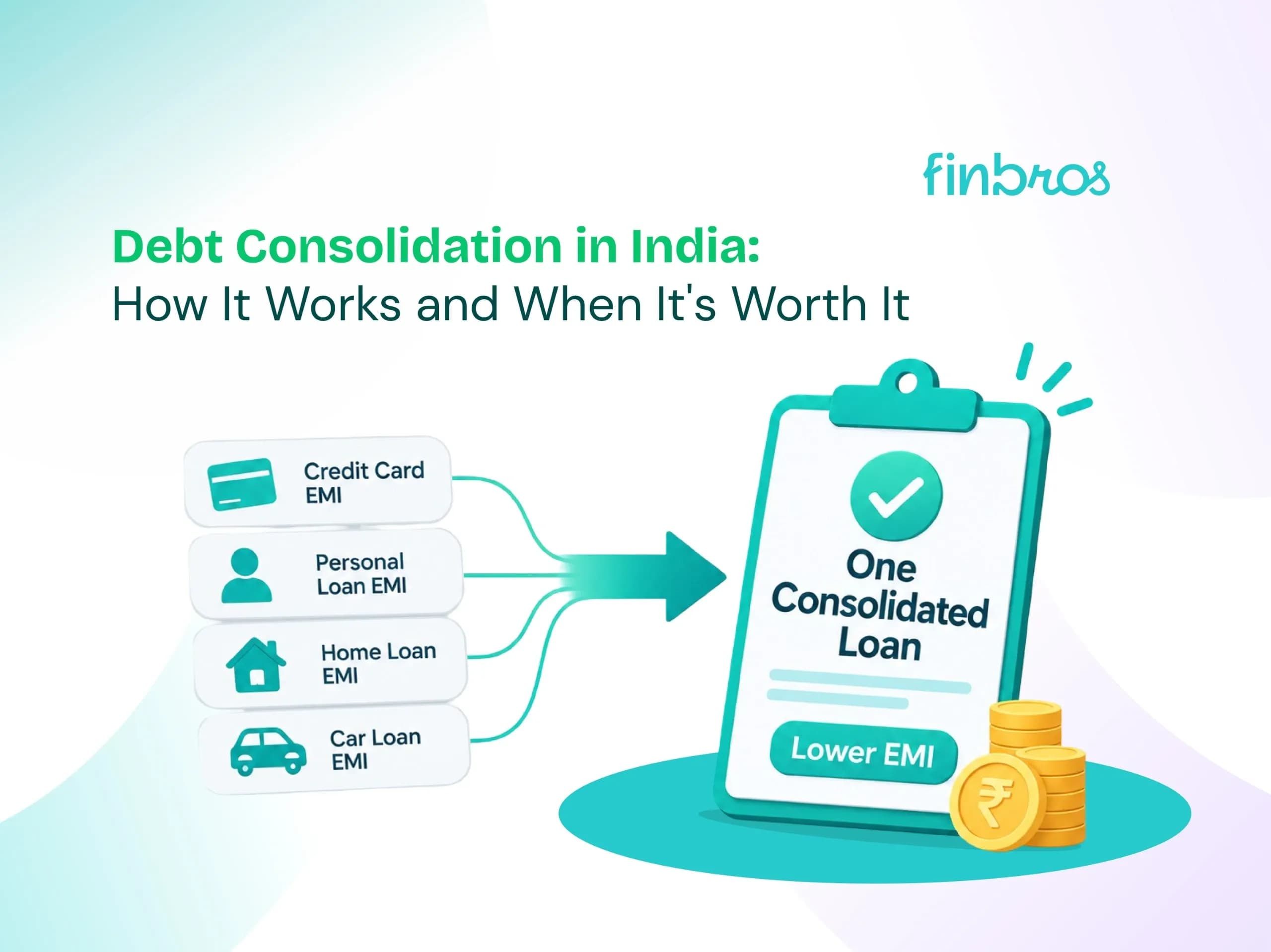
Table of Contents