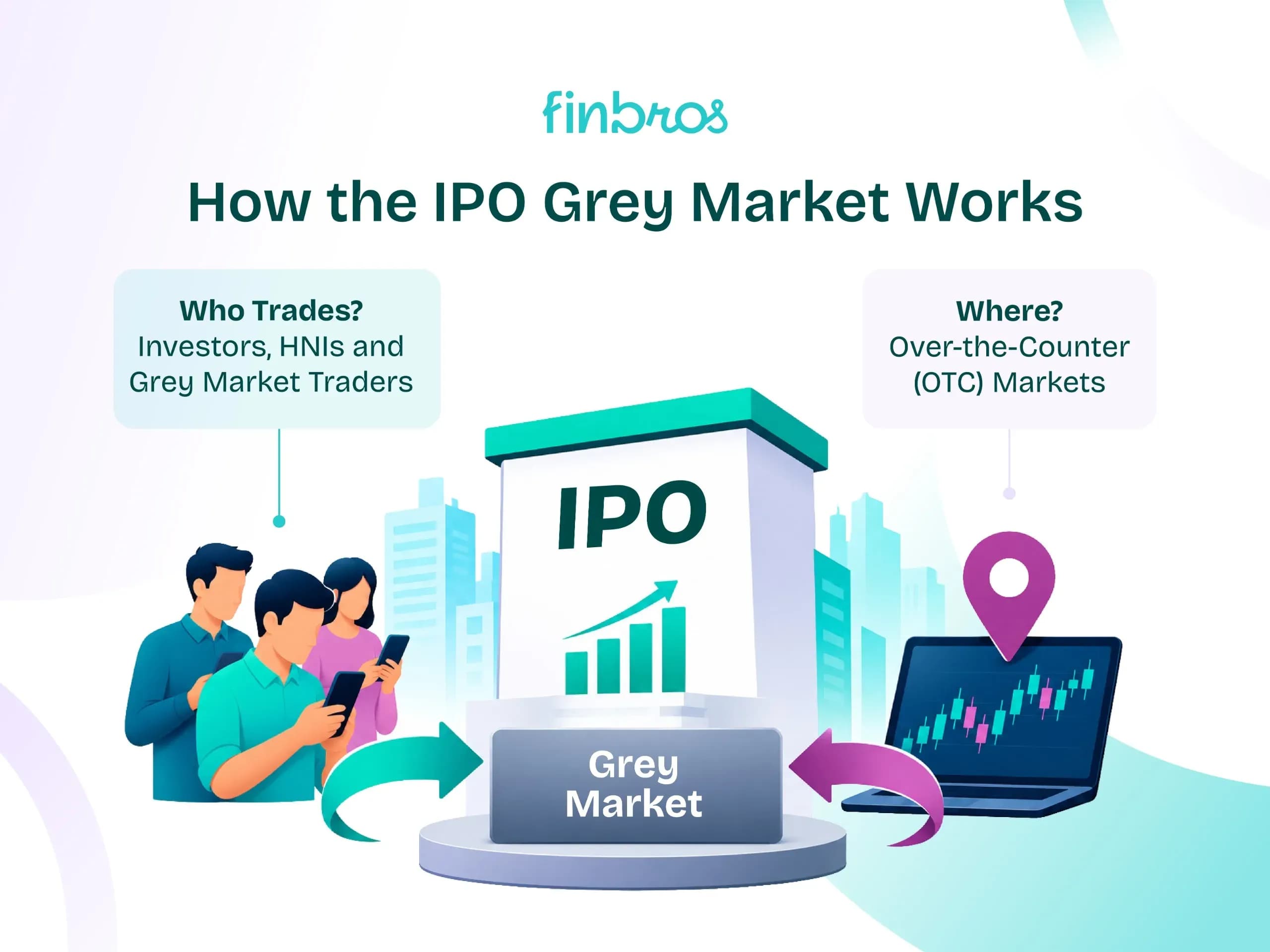


How the IPO Grey Market Works: Who Trades and Where
Key takeaways
- GMP is an unofficial price signal, not a promise of listing gains.
- Trades happen over calls and chats, not on any exchange.
- The two common deal types are Kostak (application rate) and Subject-to-Sauda (share rate).
- On November 23, 2026, SEBI advised intermediaries to stop publishing GMP figures.
- Smart investors judge an IPO on fundamentals, valuation and their own goals.
If you have ever applied for an IPO, you have probably heard someone say, "GMP is +₹40, apply it!" That little number gets more attention than the company's balance sheet. But what is it really? Who is buying and selling these shares before they even exist on the exchange? And why did India's market regulator just tell everyone to stop publishing it?
Let's break it down in plain, simple language.
Quick answer: how does the IPO grey market work?
The IPO grey market is an unofficial, off-exchange market in India where dealers, large investors and traders buy and sell IPO shares or applications before listing on NSE or BSE. The premium or discount over the issue price is called the grey market premium (GMP). Deals run on trust, settle in cash after listing, and carry no SEBI protection.
What is the grey market, in simple words?
Think of a concert where tickets are not on sale yet, but people are already quietly trading "promises" to buy them at a higher price. That is the grey market.
In the IPO world, it is an informal, over-the-counter space where people trade IPO shares (or the right to receive them) before they list on NSE (National Stock Exchange) or BSE (Bombay Stock Exchange). There is no exchange, no clearing house, and no official price screen. Everything runs on phone calls, chat messages and trust.
The price difference between the IPO's issue price and the grey market rate is called the Grey Market Premium (GMP). If an IPO is priced at ₹100 and the grey market is quoting ₹120, the GMP is ₹20. A negative number means the market expects a discount.
Who actually trades in the grey market?
It is not one single crowd. A few different players show up:
• Grey market dealers and operators: These are the middlemen who quote rates and match buyers with sellers. They keep the whole system running.
• Large investors and HNIs (High Net Worth Individuals): People with big capital who want to lock in a profit early or place a bet on the listing.
• Arbitrage traders: Experienced players who try to profit from small gaps between the grey market price and the likely listing price.
• Retail investors: Usually come in through agents or friends who know a dealer. Many never trade directly, but they follow the rates closely to decide whether to apply.
Notice what is missing? Regulators, exchanges and any form of investor protection.
Where does it happen?
Nowhere official. That is the whole point. Trades happen over phone calls, messaging apps and personal networks. Deals are agreed verbally or in chat, and the parties settle later in cash.
Because nothing is recorded on an exchange, there is no public data you can fully trust. The GMP figures you see on websites and social media are collected from dealers and shared informally, so two websites can show two different numbers for the same IPO.
How does the trading work?
There are two popular ways deals are made, and both are based on a simple handshake-style understanding.
- Trading in shares (Subject-to-Sauda): A buyer agrees to purchase IPO shares at a fixed premium, but the deal only becomes valid if the shares are actually allotted. If you get no allotment, the deal is off.
- Trading in applications (Kostak): Here the buyer pays you a fixed amount just for your application, whether or not you get shares. The buyer takes on the risk, and also the potential gains.
In both cases, the final money settles after listing, based on the actual price. If someone backs out, you have no legal route to recover your money.
A quick look at today's reported GMPs
Here are the unofficial figures being reported on tracking sites as of November 24, 2026. Please treat these purely as information, not advice.
Recently closed IPOs
| IPO | Segment | Price band | Reported GMP |
|---|---|---|---|
| Watrana Rentals | NSE Emerge | ₹232–₹245 | About +₹40 (approx. +16.33%) |
| Crystal Crop Protection | Mainboard | ₹259–₹272 | About +₹14 to +₹15 (approx. +5.15% to +5.5%) |
| Mahanadi Coalfields | Mainboard | ₹129–₹136 | ₹0 (flat) |
Upcoming IPOs
| IPO | Segment | Opens | Price band | Reported GMP |
|---|---|---|---|---|
| Shree Siddhivinayak Greentech Industries | NSE Emerge | Nov 25 | ₹130–₹142 | About +₹10 |
| Foodlink F&B Holdings | Mainboard | Nov 26 | ₹181–₹191 | About +₹15 |
| Integris Medtech | Mainboard | Nov 27 | — | ₹0 |
Figures are aggregated by unofficial platforms such as IPO Watch and IPO Premium, and they can change within hours.
Why SEBI is raising a red flag
On Monday, November 23, 2026, SEBI advised registered intermediaries and market participants to stop publishing GMP figures for upcoming IPOs. The regulator's concern is simple: these numbers are unofficial, unverified and unregulated, yet they are often presented as a signal of the likely listing price or expected returns. You can read the coverage in Business Standard and Business Today, and you can check the regulator's own updates on the SEBI website.
The key points to remember: • Grey market deals sit outside the legal investor protection framework.
• There is no dispute resolution if the other side does not pay.
• A high GMP does not guarantee a listing gain, and a low one does not guarantee a loss.
Does GMP really predict listing price?
Sometimes it is close. Often it is not. GMP reflects the mood of a small group of traders at one moment in time. Market conditions, last-minute news, subscription numbers and the overall market sentiment on listing day can all change the final result.
For example, in the list above, the same market can show a 16% premium for one issue and a flat zero for another. That tells you about demand chatter, not about the quality of the business. For a deeper explainer on how premium numbers influence expectations, see SMC's guide on GMP and listing price, IDFC FIRST Bank's explanation of grey market premium and Groww's beginner-friendly note on the grey market.
A smarter way to decide on an IPO
Instead of staring at GMP, try this simple checklist:
- Read the prospectus. Look at what the company does and how it makes money. Start with the filings on NSE and BSE.
- Check the financials. Is revenue growing? Is the company profitable? How much debt does it carry?
- Understand the use of funds. Is the money going toward growth, or mostly to existing shareholders selling out?
- Compare valuation with peers. A great business at a very high price can still disappoint.
- Decide your goal. Are you investing for the long term or chasing a quick listing pop? Your answer changes everything.
- Never go all in. Spread your money and apply only what you can afford to keep locked or lose.
Grey market vs. the official IPO market
The grey market and the stock exchange are very different places. This table shows the gap at a glance.
| Point | Grey market | Stock exchange (NSE/BSE) |
|---|---|---|
| Regulation | Outside SEBI's framework | Regulated by SEBI |
| Where trades happen | Phone calls, chats, personal networks | Exchange trading platform |
| Price transparency | Unverified, varies by source | Public, real-time prices |
| Settlement | Cash, based on trust | Cleared and guaranteed by the clearing system |
| Investor protection | None, no dispute process | Grievance and complaint systems available |
| Price reliability | Can differ from the listing price | Actual traded price |
IPO grey market terms
| Term | Meaning |
|---|---|
| Grey Market Premium (GMP) | The extra amount over the issue price at which IPO shares are informally traded |
| Issue price | The final price at which the company sells shares in the IPO |
| Kostak | A fixed amount paid for your IPO application, whether or not you get shares |
| Subject-to-Sauda (SOS) | A deal that holds only if shares are actually allotted to you |
| Listing gain | The difference between the issue price and the price on listing day |
| Price band | The range within which investors can bid in the IPO |
| Allotment | The process of deciding who gets shares when an IPO is oversubscribed |
| NSE Emerge | The NSE platform for small and medium enterprise (SME) IPOs |
What is GMP in an IPO?
GMP, or Grey Market Premium, is the unofficial amount over the issue price at which IPO shares trade before listing. A positive GMP means the market informally expects a premium. A zero or negative GMP points to flat or weak demand chatter.
Is the IPO grey market legal in India?
The grey market runs outside SEBI's regulated framework and the exchange system. It offers no investor protection or dispute resolution. SEBI's investor education material advises against dealing in it.
Who trades in the IPO grey market?
Mainly grey market dealers, large investors and HNIs, and arbitrage traders. Retail investors usually take part through agents or simply follow the rates before deciding to apply.
Where does grey market trading take place?
There is no central venue. Deals happen over phone calls, messaging apps and personal networks, and are settled in cash after listing.
What is the difference between Kostak and Subject-to-Sauda?
Kostak is a fixed payment for your IPO application, paid whether or not you get an allotment. Subject-to-Sauda is a deal on the shares that only holds if you are actually allotted them.
Does a high GMP guarantee listing gains?
No. GMP reflects the mood of a few traders at one moment. Market conditions, subscription numbers and last-minute news can change the listing price, so GMP can be wrong in either direction.
Why did SEBI ask intermediaries to stop publishing GMP?
On November 23, 2026, SEBI advised registered intermediaries and market participants to stop publishing GMP figures for upcoming IPOs. The regulator said the numbers are unofficial, unverified and unregulated, yet are often shown as signals of listing price or returns.
Can I rely on GMP to decide whether to apply for an IPO?
It is better not to. Read the prospectus, check revenue, profit and debt, compare valuation with peers, and apply only what you can afford to keep invested.
Where can I check official IPO information?
Use the company's prospectus and the IPO pages on NSE and BSE, and regulatory updates on the SEBI website. SEBI's investor portal at investor.sebi.gov.in also offers awareness material.
Final thoughts
The grey market is a fascinating, fast-moving corner of the IPO world, but it runs on trust, whispers and unverifiable numbers. Use GMP as a piece of market gossip at best, never as your investment decision. The real answers are in the company's numbers and your own goals.