


RBI D-SIB List 2026: SBI, ICICI & HDFC Bank Retain D-SIB Status
Key takeaways
- The 2026 list has no new entrants.
- All three banks stay in the same buckets as last year, so their capital buffers do not change.
- The assessment used bank data for the financial year that ended in 2026.
- D-SIB status means a bank is very large and well connected, so RBI asks it to keep a thicker safety cushion.
- It is not a government guarantee on your deposits and not a stock recommendation.
Some bank names show up in the news so often that a fresh headline about them barely registers. But this one is worth a minute of your time, especially if your salary lands in one of these banks or your savings sit in their fixed deposits.
The Reserve Bank of India (RBI) has released its 2026 list of Domestic Systemically Important Banks, or D-SIBs. The same three names are on it again: State Bank of India, HDFC Bank and ICICI Bank. Nobody moved up, nobody moved down.
Quick answer: which banks are D-SIBs in 2026?
SBI, HDFC Bank and ICICI Bank are India's D-SIBs for 2026. RBI placed SBI in Bucket 4, HDFC Bank in Bucket 2 and ICICI Bank in Bucket 1, the same buckets as in 2025. Each must hold extra Common Equity Tier 1 (CET1) capital of 0.80%, 0.40% and 0.20% of risk-weighted assets respectively, on top of the regular capital conservation buffer.
The 2026 D-SIB list at a glance
| Bucket | Bank | Extra CET1 buffer (% of risk-weighted assets) | Change from 2025 |
|---|---|---|---|
| 4 | State Bank of India | 0.80% | None |
| 2 | HDFC Bank | 0.40% | None |
| 1 | ICICI Bank | 0.20% | None |
Buckets 3 and 5 are empty. Bucket 3 carries a 0.60% buffer and Bucket 5 a 1% buffer, so they stay available if a bank grows more important to the system in future. The figures come from the RBI's bucket table and from GKToday's report on the 2026 list.
What does D-SIB mean in simple words?
Imagine a bridge held up by a few giant pillars. If one small pillar cracks, traffic carries on. If one of the giant ones fails, the whole bridge is in trouble. So engineers reinforce those big pillars more heavily than the rest.
D-SIBs are the giant pillars of India's banking system. If one of them stumbled, the shock would travel quickly through other banks, businesses and households. That is why people call them "too big to fail", and why RBI makes them keep extra capital as a shock absorber.
How does RBI choose D-SIBs?
RBI looks at how much damage a bank's failure could do to the wider system. The usual yardsticks are:
- Size: how big the bank's balance sheet is.
- Interconnectedness: how tightly it is tied to other banks and financial firms.
- Substitutability: how easily customers and markets could replace its services.
- Complexity: how complicated its business and instruments are.
- Cross-jurisdictional activity: how much it operates outside India.
The 2026 exercise used data collected from banks for the financial year that ended in 2026. RBI first issued its D-SIB framework in 2014, updated it in 2023, and publishes the names of D-SIBs every year.
How do the buckets and buffers work?
Each D-SIB lands in a bucket based on its systemic importance score. A higher bucket means a bigger extra cushion, measured in CET1 capital, which is the highest quality capital a bank holds (mostly equity and retained profits).
Here is a made-up example to see the scale. Suppose a bank has risk-weighted assets of ₹10 lakh crore and sits in Bucket 4. A 0.80% buffer means it must hold an extra ₹8,000 crore of CET1 capital, over and above its normal requirements. This is an illustration only and not SBI's actual figure.
A short timeline
| Year | What happened |
|---|---|
| 2015 | RBI named SBI as a D-SIB |
| 2016 | ICICI Bank joined the list |
| 2017 | HDFC Bank was added, so all three were D-SIBs |
| 2023 | SBI moved from Bucket 3 to Bucket 4 and HDFC Bank from Bucket 1 to Bucket 2, with the higher buffers applying from the 2025-26 financial year |
| 2024 and 2025 | Same three banks, same buckets |
| 2026 | Same three banks and buckets again |
What does it mean for your money?
If you are a saver. The extra capital gives these banks more room to absorb losses. That is reassuring, but it is not a promise that every rupee you deposit is protected. Deposit insurance through the Deposit Insurance and Credit Guarantee Corporation (DICGC) covers a limited amount per depositor per bank, so check the current limit on the DICGC website.
If you have a loan. This list does not set your interest rate. Any effect on lending costs is indirect, and the three banks already meet these buffers.
If you invest in bank stocks. The buckets are unchanged, so there is no new capital surprise from this announcement. It is not a signal to buy or sell. Look at asset quality, profitability and valuation before deciding.
D-SIB vs G-SIB: what is the difference?
| Point | D-SIB | G-SIB |
|---|---|---|
| Full form | Domestic Systemically Important Bank | Global Systemically Important Bank |
| Scope | Important to one country's banking system | Important to the world's financial system |
| Who decides | RBI, for banks in India | Global standard-setters, with RBI applying the surcharge in India |
| Indian examples in 2026 | SBI, HDFC Bank, ICICI Bank | None among Indian banks |
If a foreign G-SIB runs branches in India, it has to hold the additional CET1 surcharge that applies to it as a G-SIB, as per RBI's list.
Frequently asked questions
What is the RBI D-SIB list 2026?
It is RBI's yearly list of banks considered too important to fail. The 2026 list names SBI, HDFC Bank and ICICI Bank.
Which banks are D-SIBs in India?
State Bank of India, HDFC Bank and ICICI Bank. SBI and ICICI Bank have been on the list since 2015 and 2016, and HDFC Bank since 2017.
Which bucket is SBI in?
SBI is in Bucket 4, with an extra CET1 requirement of 0.80% of risk-weighted assets.
Which bucket are HDFC Bank and ICICI Bank in?
HDFC Bank is in Bucket 2 (0.40%) and ICICI Bank is in Bucket 1 (0.20%).
Did any bank change buckets in 2026?
No. All three banks stayed in the same buckets as in 2025.
What is CET1 capital?
Common Equity Tier 1 is a bank's core capital. It is made up mainly of common stock, share premium, retained earnings and disclosed reserves, and it is the first line of defence against losses.
Does D-SIB status mean my deposit is fully safe?
No. The status means the bank keeps extra capital. Deposit insurance is a separate system with its own limit per depositor.
Is D-SIB status good or bad for a bank?
It is neither. It reflects size and importance. The extra capital adds safety, though it also ties up money the bank could otherwise lend.
How often does RBI update the D-SIB list?
Every year. RBI is required to disclose the names of D-SIBs annually.
Glossary
| Term | Meaning |
|---|---|
| D-SIB | A bank whose failure could seriously hurt India's financial system |
| CET1 | A bank's highest quality capital, mainly equity and retained earnings |
| Risk-weighted assets (RWAs) | A bank's assets, adjusted for how risky each one is |
| Capital conservation buffer | A standard cushion banks hold on top of minimum capital |
| Bucket | The group that decides how much extra capital a D-SIB must hold |
| Systemic importance score | RBI's score that decides a bank's bucket |
Final thoughts
The 2026 D-SIB list is quiet news by design. When the same three banks stay in the same buckets, it means RBI sees no sudden change in how important each one is to the system. For you, the useful part is understanding what the label really says. It tells you a bank is big and tightly woven into the economy. It does not say your deposit is guaranteed or that the stock is a bargain.__Italic_
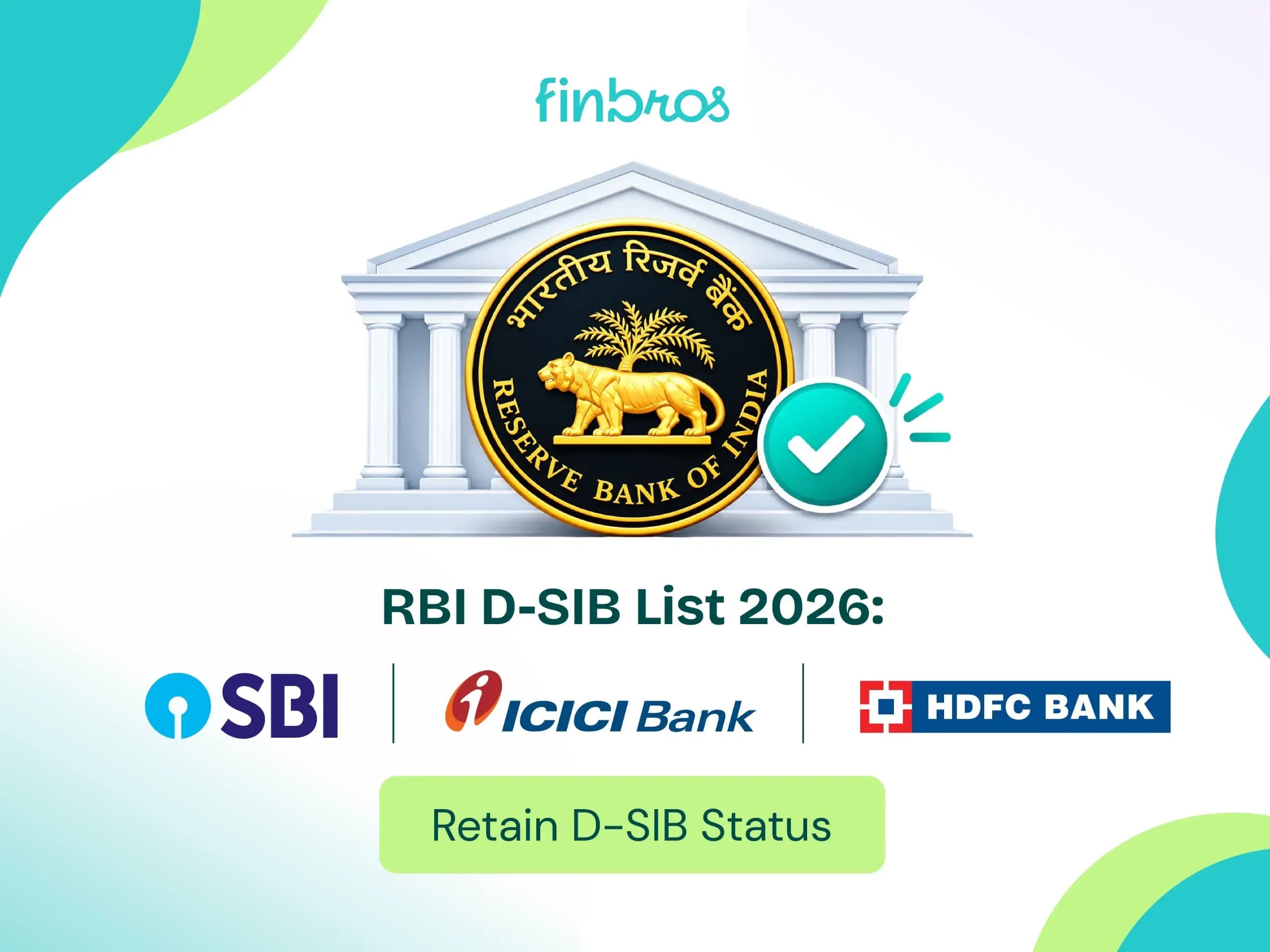
Table of Contents