


What Is a Personal Loan and How Does It Work?
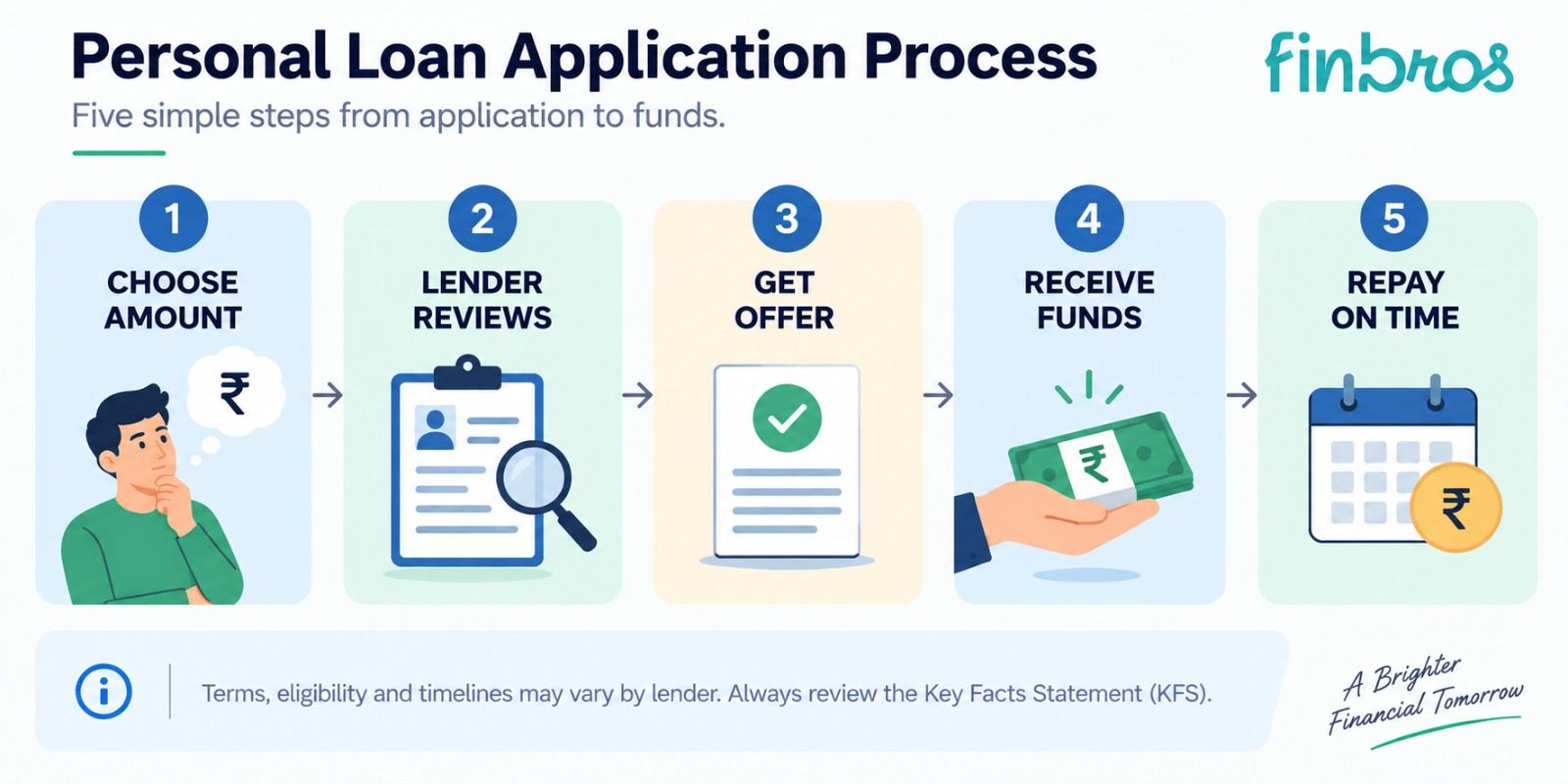
A personal loan is a type of borrowing in which a lender gives an eligible borrower a fixed amount of money that is usually repaid through monthly EMIs over a predetermined tenure. Most personal loans are unsecured, meaning collateral is generally not required. Since collateral is generally not required, lenders typically consider factors such as income, credit history, existing debt and repayment capacity when deciding whether to approve the loan and what terms to offer.
The cost of a personal loan depends on more than the amount borrowed. The interest rate, repayment tenure, applicable fees and the way the loan is repaid all affect the total amount you ultimately pay. Understanding these factors can help you compare borrowing options based on their overall cost rather than the advertised interest rate alone.
Key takeaways
- Personal loans are usually unsecured, so eligible borrowers generally do not need to pledge property, gold or another asset as collateral.
- Personal loans are repaid through EMIs, with each payment generally containing both principal and interest.
- Loan tenure affects both affordability and cost: a longer tenure usually reduces the monthly EMI but increases the total interest paid.
- The total borrowing cost is more important than the headline interest rate, because processing fees, prepayment charges and other applicable costs can affect the amount ultimately repaid.
- Loan approval and terms vary by lender and borrower profile, with factors such as income, credit history, existing debt and repayment capacity commonly considered.
- The most suitable loan is not necessarily the largest or cheapest-looking loan; it is one whose repayment terms fit the borrower's financial circumstances.
Personal Loans Snapshot
| Feature | Personal Loan |
|---|---|
| Loan type | Usually unsecured |
| Repayment | Monthly EMIs |
| Interest | Varies by lender, borrower profile, loan amount and tenure; check the applicable offer and KFS |
| Tenure | Fixed period agreed with the lender; available tenures vary by lender and borrower profile |
| Approval | Based on creditworthiness and repayment capacity; Disbursal can be as fast as 24 hours |
| Common uses | Planned expenses, emergencies and debt consolidation |
What Is a Personal Loan?
Personal Loan Meaning in Simple Terms: A personal loan is usually an unsecured loan in which an eligible borrower receives a fixed amount and repays it, with applicable interest and charges, through scheduled EMIs over an agreed tenure.
A personal loan is a form of structured borrowing in which an eligible borrower receives a defined amount and repays it over an agreed period, usually through EMIs. The important distinction is that the borrower receives a fixed loan amount rather than accessing a revolving credit limit. The lender determines the applicable rate, tenure and other terms after assessing the borrower's creditworthiness and repayment capacity.
The important question is not simply what a personal loan is, but what happens from application to final repayment.
How Does a Personal Loan Work?
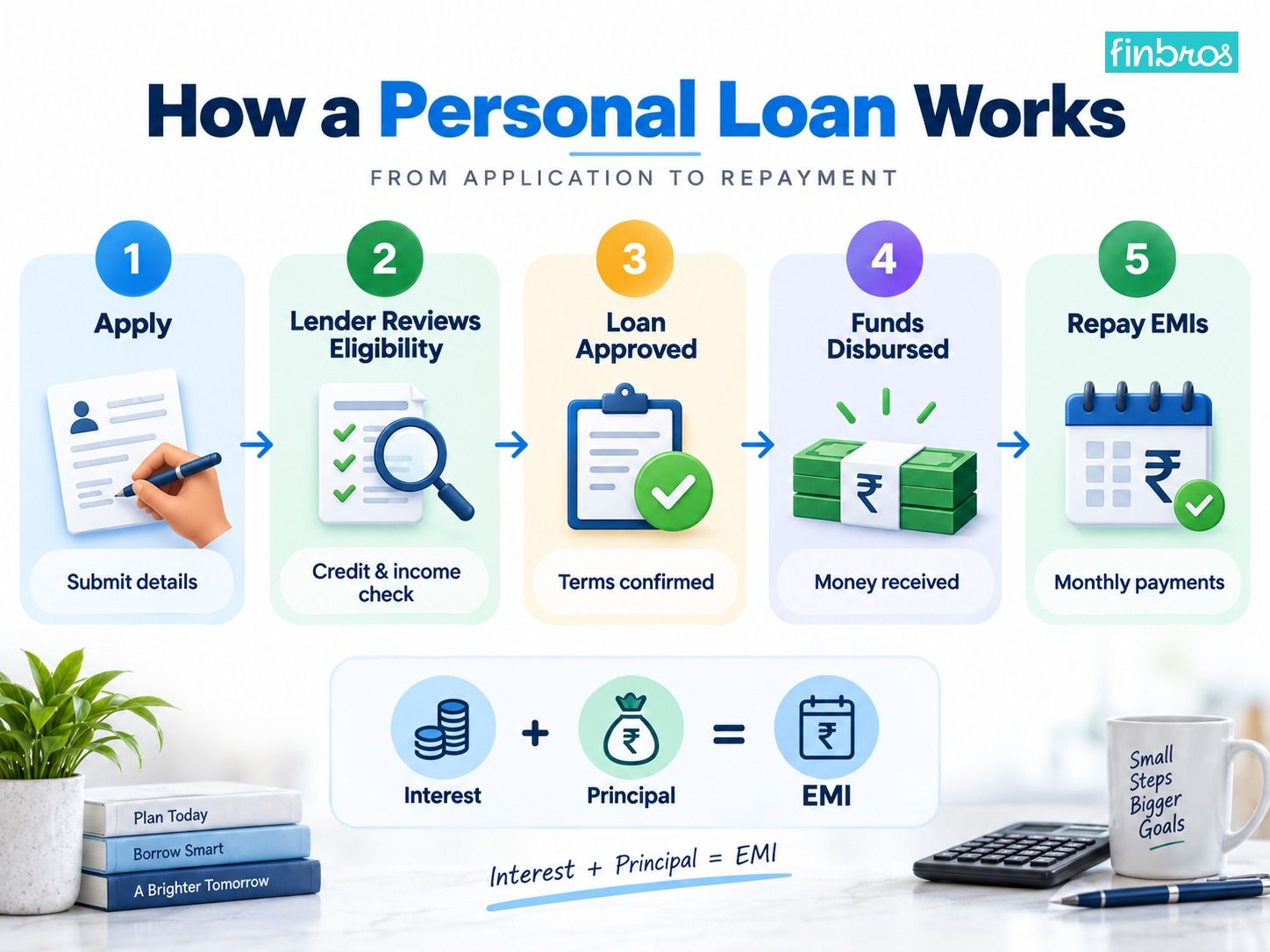
TL;DR: You decide how much you need, the lender assesses your creditworthiness and repayment capacity, the lender sets the applicable terms, the approved amount is disbursed, and you repay the loan through scheduled EMIs.
A personal loan works by providing an approved borrower with a fixed amount that is repaid over a predetermined tenure, usually through EMIs. The lender assesses the borrower's creditworthiness and repayment capacity, sets the applicable terms, disburses the approved amount and collects scheduled repayments until the loan is fully repaid.
The process can be understood in five basic stages:
1. You Decide How Much You Need
The first step is determining how much money you actually need to borrow. The loan amount should be based on the specific expense and your ability to repay it, rather than the maximum amount a lender may be willing to offer.
Borrowing more than necessary can increase both your monthly EMI and the total interest you pay over the loan term. For that reason, it is useful to estimate the required amount before applying.
2. The Lender Assesses Your Creditworthiness and Repayment Capacity
Once you apply, the lender evaluates whether you are likely to repay the loan as agreed. This assessment can include your income, employment or business profile, credit history, existing EMIs, other financial obligations and banking behaviour.
The lender may also consider the loan amount requested and the proposed repayment tenure when assessing affordability and risk. Eligibility requirements vary between lenders, so meeting one lender's criteria does not necessarily mean that another lender will approve the same application.
3. The Lender Approves or Declines the Application and Determines the Applicable Terms
After assessing your application, the lender makes a credit decision. If the application is approved, the lender provides the applicable loan terms, which may include the sanctioned amount, interest rate, repayment tenure, EMI, fees and other conditions.
Approval does not necessarily mean that you will receive the maximum amount you requested. The lender may approve a different amount or offer different terms based on its assessment of your profile and repayment capacity.
4. The Approved Amount Is Disbursed
If you accept the applicable terms and complete the lender's required formalities, the approved loan amount is disbursed according to the lender's process.
For a typical personal loan, the funds are credited to the borrower's bank account. The timing of disbursal can vary depending on the lender, verification requirements, documentation and borrower profile.
5. You Repay the Loan Through Scheduled EMIs
Once repayment begins, you make scheduled monthly instalments until the outstanding loan balance is repaid. Each EMI generally contains both a principal component and an interest component.
The amount you pay each month depends primarily on the loan amount, interest rate and repayment tenure. A longer tenure can reduce the monthly EMI, but it generally increases the total interest paid over the life of the loan.
The important point is that a personal loan is not simply the amount deposited into your account. The actual cost of borrowing includes the principal, interest and applicable charges over the complete repayment period.
How Repayment Is Structured
Your EMI usually includes two parts: principal and interest. Early in the loan term, a larger share of each payment goes toward interest, while later payments reduce the principal more aggressively.
The longer the tenure, the lower the EMI usually becomes, but the total interest paid rises. That is why a longer repayment period can make the loan look cheaper monthly while costing more overall.
What Happens Inside Each EMI?
A personal loan EMI generally consists of two main components: principal and interest.
- Principal: This is the portion of the EMI that reduces the amount you originally borrowed.
- Interest: This is the cost charged by the lender for providing the loan.
- Outstanding balance: After each repayment, the unpaid principal decreases. The remaining principal is the outstanding loan balance.
- Effect of tenure: A longer repayment tenure generally lowers the monthly EMI but increases the number of months over which interest is paid. A shorter tenure generally results in a higher EMI but can reduce the total interest paid.
The exact allocation between principal and interest changes over the repayment period. Early in the loan, a larger portion of the EMI may go toward interest. As the outstanding principal falls, a greater portion of subsequent payments goes toward reducing the principal.
How Is Personal Loan EMI Calculated? Formula and Example
Personal Loan EMI Example: How Repayment Works
Suppose you borrow ₹5 lakh for five years at an interest rate of 12% p.a. You would repay the loan through monthly EMIs, with each EMI containing both principal and interest. The exact EMI and total repayment depend on the lender's applicable rate, fees and repayment structure.
Consider a personal loan with the following terms:
| Loan Detail | Example |
|---|---|
| Loan Amount | ₹5,00,000 |
| Interest Rate | 12% p.a. |
| Loan Tenure | 5 years |
| Approximate EMI | ₹11,122/month |
| Approximate Total Repayment | ₹6.67 lakh |
| Approximate Total Interest | ₹1.67 lakh |
Note - This assumes a standard reducing-balance EMI structure and excludes any applicable fees or charges.
In this example, the borrower repays the loan through monthly EMIs. Each EMI includes both principal and interest. The exact allocation between these components changes during the repayment period as the outstanding principal decreases.
If the borrower chooses a longer tenure, the monthly EMI may become lower, but the total interest paid will generally increase. A shorter tenure usually means a higher monthly EMI but can reduce the overall interest cost.
How to Calculate Personal Loan EMI
Personal loan EMI is commonly calculated using the reducing-balance formula:
EMI = P × r × (1 + r)ⁿ ÷ [(1 + r)ⁿ − 1]
Where:
P = Principal loan amount r = Monthly interest rate n = Number of monthly instalments Example
For a ₹5 lakh personal loan at 12% p.a. for 5 years, the approximate EMI is ₹11,122 per month.
Note - The example is illustrative. Actual EMI, interest and total repayment depend on the applicable loan amount, interest rate, tenure and lender terms.
Want to check your own repayment amount?
Calculate Your Personal Loan EMI →
Interest Rates and Fees
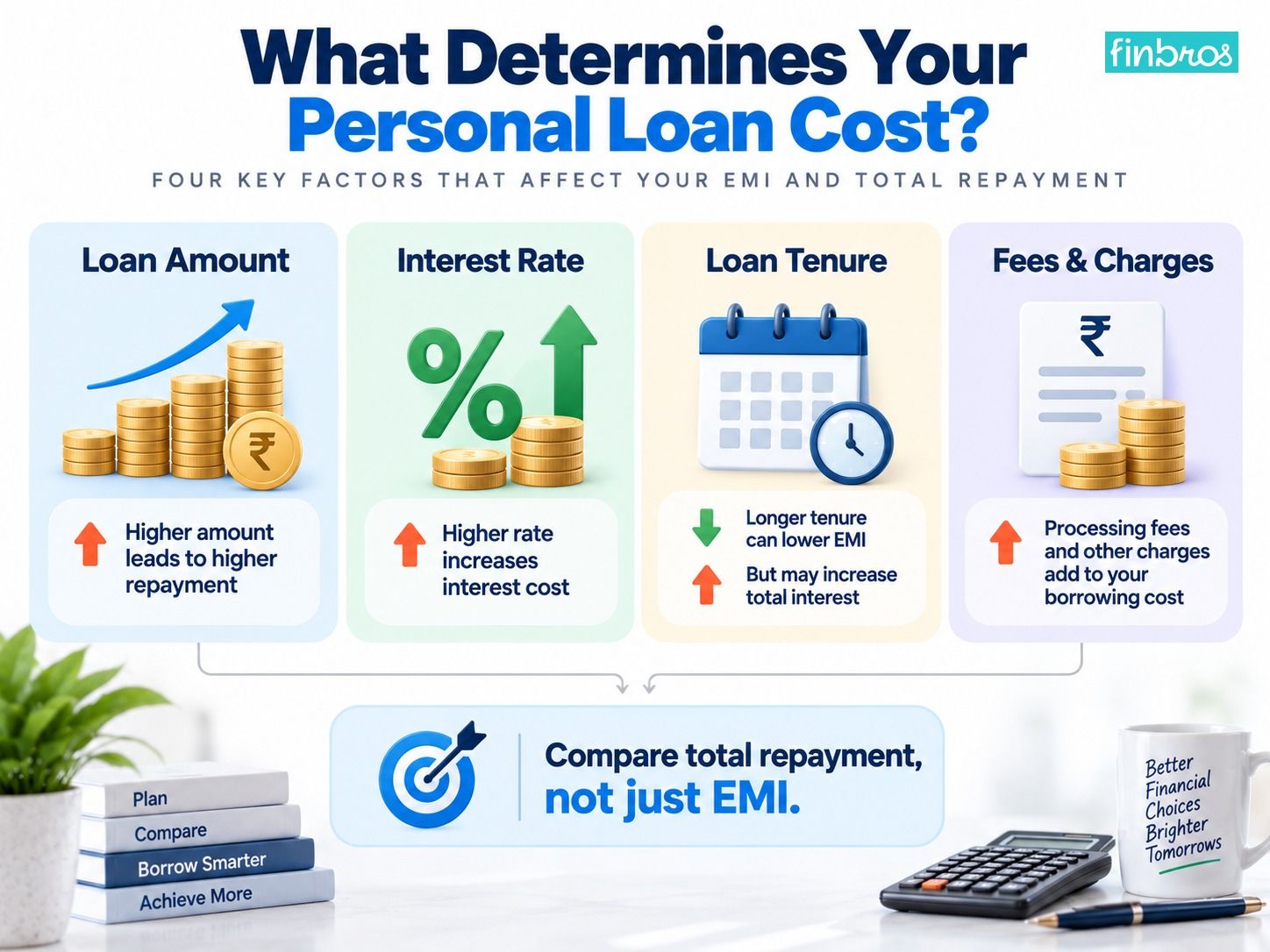
The applicable interest rate and whether it is fixed or linked to a variable benchmark depend on the lender and loan product. A fixed rate keeps repayments stable, while a variable rate can change over time and affect your EMI.
You should also check processing fees, late payment charges, prepayment rules, and foreclosure penalties. The cheapest loan is not always the one with the lowest headline rate, because fees can change the true cost significantly.
What Determines the Interest Rate?
The interest rate offered on a personal loan can depend on factors such as the borrower's credit profile, income, existing financial obligations, loan amount, repayment tenure and the lender's own credit assessment.
This means two borrowers applying for similar loan amounts may not necessarily receive identical interest rates or loan terms.
What Other Charges Should You Check?
The interest rate is only one part of the cost of borrowing. Depending on the lender and loan agreement, you may also need to consider:
- Processing fees
- Late payment charges
- Prepayment or foreclosure charges
- Other applicable fees or charges
Why the Interest Rate Is Not the Total Cost
A loan with a lower advertised interest rate is not automatically the cheapest option. The total cost depends on the interest charged over the repayment period as well as applicable fees and other charges.
Before choosing a loan, compare the total repayment amount, not just the headline interest rate or monthly EMI.
What Is the Key Facts Statement (KFS)?
Before accepting a loan, borrowers should review the lender-provided Key Facts Statement (KFS), where applicable. It presents key information about the loan in a standardized format and helps borrowers understand important terms and costs before entering into the agreement.
For loans covered by the RBI's KFS framework, the statement is intended to help borrowers understand the key terms and all-in cost of credit before entering into the loan agreement.
The Annual Percentage Rate (APR) is also useful when comparing borrowing costs because it reflects the annual cost of credit, including the applicable interest and associated charges covered by the framework.
Secured vs Unsecured Loans
Most personal loans are unsecured, which means no collateral is required. That makes them more accessible, but it also means lenders may charge higher interest than on loans backed by property or another asset.
A secured loan uses an asset as security, while an unsecured loan depends more heavily on credit quality and income. In real-world terms, unsecured loans are simpler to get in many cases, but they also require stricter repayment discipline.
| Feature | Secured Loan | Unsecured Personal Loan |
|---|---|---|
| Collateral | Usually required | Usually not required |
| Lender's security | Backed by an eligible asset | Primarily based on the borrower's creditworthiness and repayment capacity |
| Interest cost | May be lower depending on the product and borrower | May be higher because no asset is pledged |
| Approval assessment | Considers the borrower and the pledged asset | Relies more heavily on the borrower's financial and credit profile |
| Default risk | The pledged asset may be at risk, subject to the loan agreement and applicable rules | The borrower may face penalties, credit consequences and other consequences under the loan agreement and applicable law |
A personal loan is generally unsecured, which is one reason it can provide access to funds without requiring the borrower to pledge property, gold or another asset.
How Do Lenders Assess Personal Loan Affordability?
TL;DR: Lenders may consider income stability, existing EMIs, overall debt burden, credit history, employment or business profile, requested loan amount, tenure, banking behaviour and repayment capacity when assessing a personal loan application.
Meeting a lender's basic eligibility criteria does not necessarily mean that a particular personal loan amount will be affordable or approved. Lenders typically assess the borrower's overall financial profile to determine whether the requested borrowing is appropriate relative to their income, existing obligations and expected ability to repay.
The exact assessment process and factors considered can vary between lenders, but the following areas commonly influence how a lender evaluates personal loan affordability and repayment risk.
| Factor | Why it matters |
|---|---|
| Income stability | Indicates ability to maintain repayments |
| Existing EMIs | Shows current debt commitments |
| Credit history | Indicates past repayment behaviour |
| Employment/business profile | Helps assess income stability |
| Loan amount | Determines repayment obligation |
| Tenure | Affects EMI and total interest |
| Banking behaviour | Provides cash-flow context |
| Repayment capacity | Helps determine sustainable borrowing |
Not sure whether you may qualify?
Check your personal loan eligibility →
Why Do Lenders Ask for These Documents?
Personal loan documents are primarily used by lenders to verify information about the borrower and assess their ability to repay the loan. The specific documents requested can vary depending on the lender, the borrower's employment or business profile, the loan amount and other aspects of the application.
Rather than viewing documentation as a checklist, it is useful to understand what different categories of documents help the lender establish.
KYC Documents Establish Identity:
Know Your Customer (KYC) documents help lenders verify that the person applying for the loan is who they claim to be. This supports identity verification and helps lenders meet applicable customer identification and regulatory requirements.
Address Proof Establishes Residence:
Address-related documents help the lender verify the borrower's residential details. This can be relevant to customer identification, application verification and the lender's assessment of the borrower's profile.
Salary and Income Documents Establish Earning Capacity:
Salary slips, salary certificates and other income-related documents can help lenders verify the borrower's income and assess whether the stated earnings are consistent and sufficient to support the proposed loan repayment.
For salaried borrowers, these documents can provide evidence of regular employment income and its continuity.
Bank Statements Provide Cash-Flow Information:
Bank statements can give lenders a broader view of how money moves through the borrower's account. They may help establish the regularity of income credits, existing financial commitments, spending and repayment patterns, and the borrower's overall cash-flow position.
This can provide context that may not be apparent from income documents alone.
ITR and Business Documents Help Establish Self-Employed Income:
For self-employed borrowers and business owners, income may not be reflected through regular salary slips. Income Tax Returns (ITRs), financial statements and relevant business documents can therefore help lenders assess the nature, consistency and sustainability of business or professional income.
Depending on the borrower and lender, documents relating to business registration, tax compliance or other aspects of the business may also be requested.
Existing Debt Information Establishes Current Obligations:
Information about existing loans, credit card balances and other repayment obligations helps lenders understand how much of the borrower's income may already be committed to debt.
This allows the lender to assess the potential impact of an additional personal loan on the borrower's overall repayment capacity.
Why This Documentation Matters?
Taken together, these documents allow lenders to verify key information provided in the application and build a more complete picture of the borrower's financial position. The purpose is not simply to establish whether a borrower meets a basic eligibility condition, but to support the lender's assessment of identity, income, existing obligations and repayment capacity.
Note: Exact documentation varies by lender, borrower profile and loan amount.
What Happens After You Apply for a Personal Loan?
The lender generally reviews the application and supporting documents, verifies relevant information, assesses creditworthiness and repayment capacity, communicates the loan terms if approved, disburses the approved amount after the required formalities, and begins repayment according to the agreed schedule.
When Is a Personal Loan Suitable?
TL;DR: A personal loan may be suitable for a defined financial need when you can comfortably afford the EMI, do not want to pledge collateral and find the total borrowing cost reasonable compared with available alternatives.
A personal loan may be suitable when you need to meet a specific financial requirement and can reasonably afford the resulting monthly repayments. Because personal loans are generally unsecured, they can provide access to funds without requiring the borrower to pledge an asset as collateral.
However, a personal loan is not automatically the best option for every financial need. Before borrowing, consider the purpose of the loan, the repayment period, the total borrowing cost and whether the monthly EMI fits comfortably within your budget.
When a Personal Loan May Be Suitable
A personal loan may be worth considering in situations such as:
You have a defined, one-time expense
A personal loan can be appropriate when you need a specific amount for a planned or unavoidable expense and have a reasonably clear idea of how much you need to borrow. Borrowing a defined amount can make it easier to assess the loan's total cost and plan for repayment.
Predictable monthly repayments are important to you
Personal loans are typically repaid through fixed or otherwise predetermined EMIs over an agreed loan tenure. This can make monthly budgeting easier because you know the repayment obligation in advance and can incorporate it into your regular expenses.
You prefer not to pledge collateral
Personal loans are generally unsecured, meaning you do not normally have to offer property, a vehicle or another asset as security for the loan. This may make them an option for borrowers who do not want to risk an asset or do not have suitable collateral to offer.
You can comfortably afford the EMI
The fact that you qualify for a particular loan amount does not necessarily mean that borrowing that amount is affordable. A personal loan may be suitable only when the EMI can be accommodated alongside your existing expenses, debt obligations and other financial commitments without placing excessive pressure on your finances.
The overall borrowing cost is reasonable compared with the alternatives
The interest rate is only one part of the cost of borrowing. Consider the total amount repayable, applicable processing fees, other charges and the effect of the loan tenure. Comparing these costs with alternatives available for the same financial requirement can help you determine whether a personal loan is appropriate.
When a Personal Loan May Not Be Suitable
A personal loan may not be appropriate if taking on another monthly repayment would strain your budget or leave little room for unexpected expenses.
You may also want to reconsider borrowing if:
- You are unsure how much you actually need to borrow.
- The expense is recurring and borrowing would only postpone an ongoing cash-flow problem.
- You would need to take another loan to repay the personal loan or meet your regular expenses.
- The EMI would leave you with insufficient funds for essential expenses and existing financial commitments.
- The total cost of the personal loan is significantly higher than a suitable alternative.
- You are borrowing for a discretionary expense that you cannot comfortably afford without debt.
Ultimately, a personal loan should be evaluated based on both why you need the money and whether you can repay it comfortably. Comparing the total cost, repayment terms and available alternatives before applying can help you make a more informed borrowing decision.
What Are the Trade-Offs of a Personal Loan?
Focus on:
| Trade-off | What it means |
|---|---|
| Predictability vs cost | Fixed EMIs can make budgeting easier, but a longer tenure may increase total interest |
| No collateral vs pricing | Unsecured borrowing may cost more than secured alternatives |
| Fast access vs affordability | Easy access does not mean the EMI is affordable |
| Flexible use vs discipline | Broad-purpose borrowing can make unnecessary borrowing easier |
| Lower EMI vs total repayment | A lower monthly payment can result in a higher overall cost |
Personal Loan vs Credit Card
TL;DR: A personal loan gives you a fixed amount repaid through EMIs over a set tenure, while a credit card gives you a revolving credit limit that you can use, repay and use again.
Both personal loans and credit cards let you borrow money, but they work differently and suit different needs. A personal loan is generally better suited to a defined, larger expense that you plan to repay over several months or years. A credit card is generally better suited to short-term spending that you can repay in full by the due date.
| Feature | Personal Loan | Credit Card |
|---|---|---|
| Type of credit | Fixed loan amount | Revolving credit limit |
| Repayment | Scheduled EMIs over an agreed tenure | Monthly bill; full or partial payment |
| Interest | Charged on the outstanding loan as per loan terms | Charged when the full bill is not paid by the due date, as per card terms |
| Best suited for | Defined, larger expenses repaid over time | Short-term spending repaid in full |
| Cost predictability | EMI and tenure known in advance | Cost can rise quickly if balances are carried forward |
If you are likely to carry a large balance for several months, compare the total cost of doing so on a credit card with the total cost of a personal loan before deciding.
What to Check Before You Borrow
TL;DR: Compare the loan amount, interest rate and APR where applicable, EMI, tenure, total repayment, fees, prepayment terms and lender details before accepting a personal loan.
Before taking a personal loan, check the EMI, total repayment amount, interest rate type, fees, and prepayment conditions. You should also confirm that the lender is properly authorised or regulated in the relevant market.
When choosing a personal loan, go through this checklist:
1. Loan Amount
Borrow only the amount required for the intended expense. A higher sanctioned amount does not mean that borrowing the maximum amount is financially sensible.
2. Interest Rate and APR
Check the applicable interest rate and understand whether it is fixed or variable, where relevant to the product.
3. Monthly EMI
Make sure the EMI fits comfortably within your monthly budget after accounting for essential expenses, existing EMIs, savings and unexpected costs.
4. Total Repayment
Compare the total amount you will repay over the complete loan tenure. This can provide a better picture of the loan's cost than the EMI alone.
5. Fees and Other Charges
Review processing fees, late payment charges, prepayment or foreclosure charges and any other applicable costs before accepting the loan.
6. Repayment and Prepayment Terms
Understand when repayments begin, how they are collected and whether any conditions or charges apply if you repay the loan early.
7. Lender and Loan Terms
Confirm the lender's identity, applicable terms and relevant authorisations before proceeding. Do not rely solely on advertisements or headline rates when evaluating a loan.
Before applying, also avoid submitting multiple applications indiscriminately and review the lender's eligibility criteria and loan terms carefully.
Note: A lower advertised interest rate does not necessarily mean a lower overall borrowing cost, because fees, tenure and other applicable charges can affect the total amount repaid.
Common Mistakes to Avoid
TL;DR: Most personal loan mistakes come from focusing only on the loan amount, the EMI or the headline interest rate instead of the total cost and your ability to repay.
Avoiding these common mistakes can help you borrow more responsibly:
- Borrowing the maximum amount offered: A higher sanctioned amount does not mean borrowing that much is financially sensible. Borrow only what the expense requires.
- Comparing only the EMI: A lower EMI often comes from a longer tenure, which can increase the total interest paid.
- Looking only at the headline interest rate: Processing fees, prepayment or foreclosure charges and other costs can change the true cost of the loan.
- Not reviewing the Key Facts Statement: The KFS sets out the key costs and terms of the loan in a standardised format.
- Taking on an EMI that strains your budget: The EMI should fit alongside essential expenses, existing EMIs, savings and unexpected costs.
- Submitting multiple applications indiscriminately: Review each lender's eligibility criteria and terms before applying.
- Not checking the lender: Confirm the lender's identity and relevant authorisations instead of relying only on advertisements.
- Using new loans to repay existing debt repeatedly: Borrowing to cover recurring expenses or other loans without a sustainable repayment plan can increase financial pressure.
Personal Loans in India
TL;DR: In India, personal loans are offered by banks, NBFCs and other regulated lenders, and borrowers should check the lender's authorisation, the Key Facts Statement and the total cost before accepting a loan.
Personal loans in India are offered by banks, non-banking financial companies (NBFCs) and other lenders regulated by the Reserve Bank of India (RBI). Before borrowing, confirm that the lender is properly authorised or regulated and review the loan terms provided by the lender, including the Key Facts Statement, where applicable.
For India-focused borrowing, it is also sensible to track how broader lending conditions are changing. RBI has introduced and updated measures affecting consumer and unsecured lending, including requirements relating to borrower disclosures, lending practices, and risk management. Because these requirements can change, borrowers should rely on the lender's current KFS and applicable RBI guidance when evaluating a loan.
Eligibility criteria, interest rates, fees, tenures and documentation requirements vary between lenders and depend on the borrower's profile, so it is worth comparing offers before applying.
FAQs
What Is the Difference Between Loan Principal and Interest?
The principal is the amount you borrow from the lender, while interest is the cost charged for providing the loan. Each personal loan EMI generally includes both principal and interest, although the proportion allocated to each changes during the repayment period.
Why Does a Longer Personal Loan Tenure Increase Total Interest?
A longer tenure spreads repayment over more months, which can reduce the monthly EMI. However, interest is generally charged over a longer period, so the total interest paid can increase. Compare both the EMI and total repayment amount before choosing a tenure.
Does a Lower EMI Always Mean a Cheaper Personal Loan?
No. A lower EMI can result from choosing a longer repayment tenure, which may increase the total interest paid. Compare the total repayment amount, interest rate and applicable fees rather than evaluating a personal loan only by its monthly EMI.
What Is the Total Cost of a Personal Loan?
The total cost is the overall amount you are required to pay under the loan terms. It generally includes the principal and interest plus applicable charges such as processing fees, prepayment or foreclosure charges and other lender-specific costs.
What Is APR on a Personal Loan?
APR, or Annual Percentage Rate, represents the annualised cost of credit and can include applicable interest and associated charges covered under the relevant framework. It can provide a more useful basis for comparing borrowing costs than looking at the advertised interest rate alone.
What Is a Key Facts Statement (KFS) for a Personal Loan?
A Key Facts Statement is a standardised disclosure provided by the lender that sets out important information about a loan, including key costs and terms. Reviewing the KFS before accepting a loan can help you understand the applicable borrowing cost and repayment obligations.
How Much Personal Loan Can You Afford?
The amount you can technically qualify for is not necessarily the amount you can comfortably afford. Affordability depends on income, existing EMIs, essential expenses, savings, interest rate and tenure. Before applying, estimate the proposed EMI alongside your existing financial commitments and leave sufficient room for essential expenses and unexpected costs.
When Should You Avoid Taking a Personal Loan?
A personal loan may be unsuitable when the expense is unnecessary, the amount you need is uncertain or the EMI would put excessive pressure on your budget. It may also be risky to use a new loan repeatedly to cover existing debt or recurring expenses without a sustainable repayment plan.
Conclusion
A personal loan can provide a structured way to fund a defined financial need without pledging an asset as collateral. However, the decision to borrow should be based on more than the amount a lender is willing to offer.
Before taking a personal loan, consider the loan amount, interest rate, EMI, repayment tenure, total repayment amount, applicable fees and your ability to repay comfortably. A longer tenure may reduce the monthly EMI but can increase the total interest cost, while a lower advertised interest rate does not necessarily mean a lower overall borrowing cost.
The right approach is to borrow only what you need, understand the complete repayment obligation and compare the applicable terms before making a decision.
FinBros network disclosure: The loan amounts, interest rates, processing fees, tenures and other figures mentioned in this article are based on typical offerings from lenders in the FinBros network. They are indicative and may vary by lender and borrower. Actual loan offers are subject to lender eligibility criteria, credit assessment, repayment capacity and applicable terms and charges. The figures should not be interpreted as guaranteed rates, fees, loan amounts or approval timelines.
Ready to compare your options?
Compare available personal loan offers and review the applicable interest rate, EMI, tenure and fees before applying.

Table of Contents