


Why Does Crude Oil Affect the Rupee? USD, AED & Riyal to INR Today.
Key takeaways
- Oil is priced in dollars, so every rise in crude raises India's dollar bill.
- Brent climbed above $96 on Middle East supply fears.
- The rupee closed at 92.44 on Thursday, pulled down by costly crude and worries about US tariffs.
- AED and SAR rates follow the dollar, so they feel the same pressure.
- A weaker rupee can raise fuel, transport and import costs.
Quick answer: why does crude oil affect the rupee?
When crude oil gets costlier, the rupee gets weaker. India buys most of its oil from other countries and pays for it in US dollars. Costlier oil means India needs more dollars, so more people want dollars and the rupee loses value.
This is happening today. Brent crude traded around $96.46 a barrel on 27 November 2026, and WTI was near $85.71. The rupee opened at 92.52 per dollar, down from a previous close of 92.45, and traded near 92.62 in early deals.
Brent crude price today
Brent crude is trading around $96.46 a barrel on 27 November 2026, while WTI is near $85.71. Brent is the world's main oil price, and WTI is the main oil price in the US. You can read more about both benchmarks on the US Energy Information Administration website. Brent has gained more than 6% over the last two sessions, which is why oil is back in the headlines.
Key terms in simple words
| Term | Meaning |
|---|---|
| Brent crude | The international benchmark price for oil, quoted in US dollars per barrel |
| WTI | West Texas Intermediate, the main US oil benchmark |
| USD/INR | The number of rupees needed to buy one US dollar |
| Forward premium | The extra cost of fixing today the dollar rate for a future date. A higher cost often means people expect the rupee to weaken |
| Mid-market rate | The middle rate between buying and selling, before any bank fees |
| Risk premium | Extra price added because people fear oil supply may stop |
Why crude oil is in the news today
The supply scare behind the price jump
According to Reuters, Brent futures hovered near this month's high on Friday. Attacks on oil ships near the Strait of Hormuz and on Saudi oil facilities raised fears about oil supply. The Houthis said they hit Saudi Arabia's largest oil refinery, and Iran said mines struck ships in the Strait of Hormuz.
Brent gained more than 6% over the previous two sessions. It was on track for its first weekly gain in four weeks. Fewer traders were active after US Thanksgiving, which may have made the move bigger.
A rally with a catch
But it is not all one-sided. NDTV Profit reported that crude is still down about 20% for the month, even after this jump. Analysts also say there may be too much oil in the world in the last three months of the year, and US oil stocks are rising. Both can limit further price gains.
So today's jump comes from fear of war and supply trouble. It does not prove that oil will keep rising. This matters if you are planning anything around the rupee.
How do oil prices affect the Indian rupee?
Why does the rupee fall when crude oil rises? The five-step chain
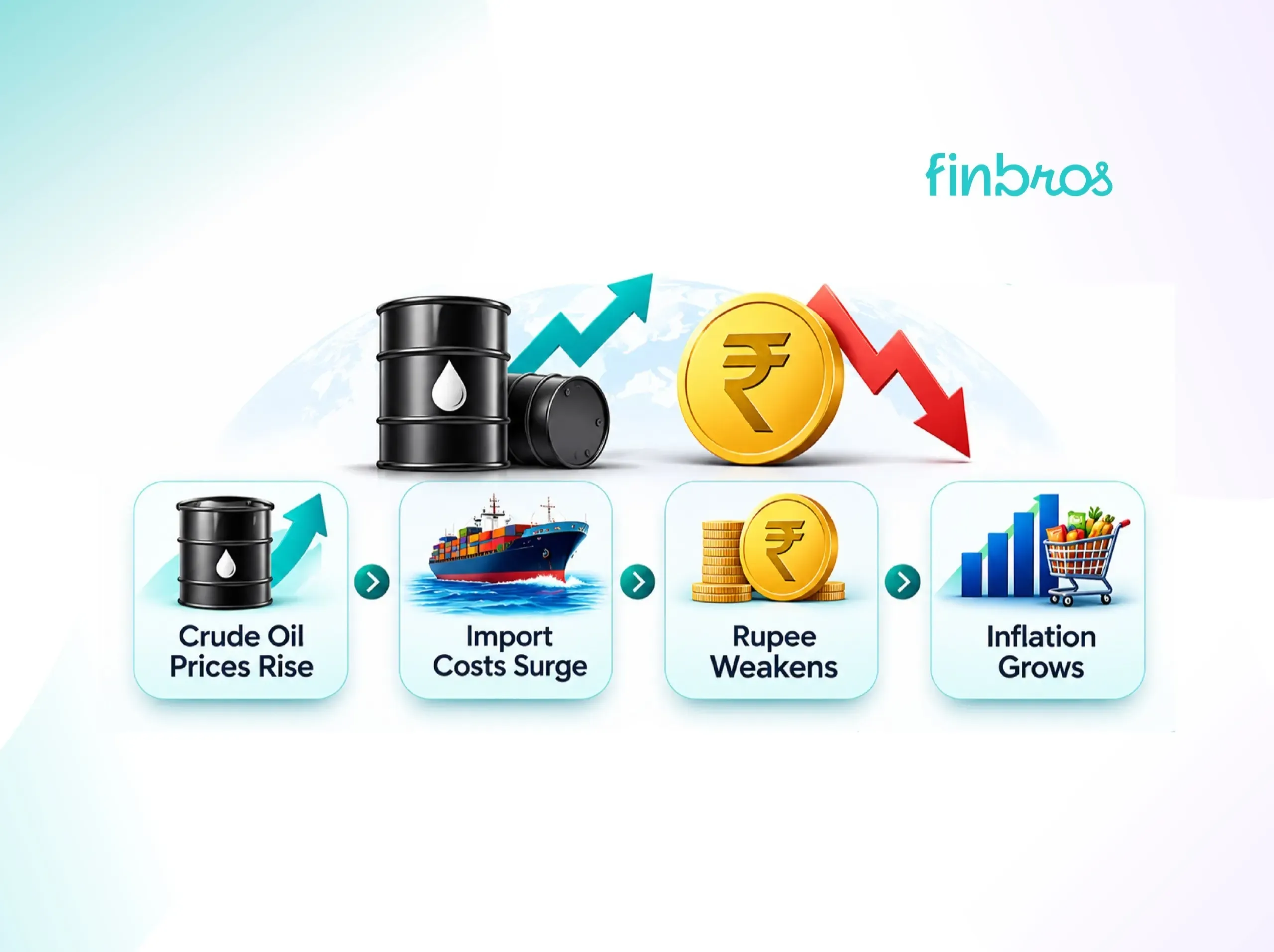
- Global crude rises. Supply fears lift Brent.
- India's import cost rises. Each barrel now costs more dollars.
- Importers buy more dollars. Refiners need foreign money to pay for the oil.
- USD/INR goes up. More people want dollars, so the rupee gets weaker.
- Inflation risk grows. Costlier imported fuel makes transport and factory costs go up.
The numbers behind the link
India's crude oil import bill rose 26% year on year to $49 billion in April–June 2026. Import volumes actually fell 18% in that period, so price, not quantity, drove the jump. This shows how much India depends on the oil price. For official oil import and consumption data, see the Petroleum Planning & Analysis Cell.
The cost of protecting against a falling rupee is also rising. The one-year USD/INR forward premium is at its highest since January 2022. This means traders expect more pressure on the rupee and are paying more to protect themselves.
Crude oil price and rupee relation at a glance
In simple words: when crude goes up, the dollar usually gets costlier in rupees too. Other things, like foreign money coming in and global interest rates, can make the effect smaller or bigger. This table puts the main numbers in one place.
| Indicator | Latest reading |
|---|---|
| Brent crude | About $96.46 a barrel |
| WTI crude | About $85.71 a barrel |
| USD/INR open (27 November 2026) | 92.52 |
| USD/INR previous close | 92.45 |
| India's crude import bill, April–June 2026 | $49 billion, up 26% year on year |
| Import volumes, April–June 2026 | Down 18% |
| One-year USD/INR forward premium | Highest since January 2022 |
Not only about oil
Crude is a big reason, but not the only one. Business Standard says the rupee's problems go deeper than costly crude and the West Asia conflict. It points to strong dollar demand and money leaving India. Thursday's fall, for example, was linked to both costly crude and fears of more US tariffs.
The rupee has also had a strong month overall. Business Standard reported that the rupee gained about 2.46% in November up to 20 November. It was helped by nearly $13 billion of foreign money coming in, lower crude prices and dollar sales by exporters. Business Today's analysis also explains how weak this recovery can be.
In short, oil adds pressure, while foreign money flows, global interest rates and the strength of the dollar decide how much the rupee actually moves.
USD, AED and riyal to INR today
Live rates snapshot
Many readers search for conversion rates alongside oil news. Google Trends data for India over the past 24 hours showed rising interest in queries such as "aed to inr", "dollar in rupees" and "riyal in indian rupees". Interest in "Indian Rupee" scored 60 against just 3 for "crude oil".
Here are mid-market rates reported on 27 November 2026. They are indicative and change through the day. For the official daily reference rate, check FBIL.
| Currency | Approx. value in INR | Source note |
|---|---|---|
| 1 US dollar | About 92.5–92.6 | Early trade |
| 1 UAE dirham (AED) | About 25.13–25.16 | Mid-market sites |
| 1 Saudi riyal (SAR) | About 24.60–24.66 | Mid-market sites |
Both the dirham and the riyal are closely tied to the US dollar, so their rupee values move with USD/INR. You can read about their currency policies on the Central Bank of the UAE and Saudi Central Bank websites. If the rupee weakens against the dollar, it usually weakens against AED and SAR by a similar amount. This is our own reasoning, not a figure from the sources below.
What this means for remittances
Millions of Indians work in the Gulf and send money home. A weaker rupee means each dirham or riyal buys more rupees, which can benefit the families receiving money. Use the table only as a guide. Check the actual rate with your bank or money transfer service, because fees change how much you receive.
Quick estimates at the rates above, before any fees:
- 1,000 AED is roughly 25,100 INR.
- 1,000 SAR is roughly 24,600 INR.
- 100 USD is roughly 9,250 INR.
Who gains and who loses from a weaker rupee
Winners and losers
A falling rupee is not bad for everyone. It shifts costs and income across the economy.
| Group | Likely impact |
|---|---|
| Importers | Pay more rupees for dollar-priced goods |
| Airlines | Higher fuel costs, since aviation fuel is crude-linked |
| Paints, tyres, logistics | Profits squeezed by costlier crude-based raw materials |
| Exporters | Foreign earnings convert into more rupees |
| Gulf remittance receivers | More rupees per dirham or riyal |
| Consumers | Possible higher fuel and transport prices |
Oil companies can see both good and bad effects. They may earn more from refining, but the government's influence on petrol and diesel prices can limit how much they can pass on to customers.
The inflation angle
Rising prices are the main worry for families. Economic Times reported that, with Brent above $96, worries about India's import costs and price rise have grown. Costlier fuel also makes transport of goods, food and factory production costlier, so prices can go up well beyond the petrol pump.
How much of this reaches you depends on taxes, subsidies and government decisions. Costlier crude does not always mean an equal rise in petrol prices in India.
When fuel and import costs rise, household budgets can feel the squeeze. If you are weighing a loan, you can compare personal loan offers from 30+ banks and NBFCs on Finbros. Checking offers does not affect your credit score.
Can the RBI protect the rupee?
The Reserve Bank of India can sell dollars to calm sharp moves in the rupee. This reduces the ups and downs, but it cannot fully cancel the effect if oil stays costly for long.
The rupee has shown it can bounce back when conditions improve. It fell as low as 96.96 per dollar and then recovered to 92.24, helped by RBI steps and falling commodity prices. This shows how fast the mood can change when crude gets cheaper and foreign money comes in.
Reuters noted that foreign money and a positive mood are giving the rupee some support, even as oil tests its rally. Share markets show the same tension. Sensex and Nifty opened lower as Brent jumped and war worries weighed on the mood. For another view on where the rupee may go, see OCBC's forecast as covered by investingLive.
What to watch next
- Brent crude: a sustained move above $96 would keep pressure on USD/INR.
- Middle East news: further attacks on Saudi facilities or Hormuz shipping can lift oil quickly.
- USD/INR levels: early trade on 27 November was around 92.5–92.6.
- RBI action: dollar sales or other steps can change the short-term direction.
- US tariff news: trade-war headlines also weighed on the rupee this week.
- Foreign investor flows: strong inflows of foreign money can reduce the pressure from oil.
Frequently asked questions
Why does crude oil affect the Indian rupee?
Crude is priced in dollars and India imports most of its oil. Higher prices raise dollar demand, which weakens the rupee.
What is the crude oil price and rupee relation?
When crude oil gets costlier, India needs more dollars to pay for it, so the dollar gets costlier in rupees and the rupee weakens. Foreign money flows and global interest rates can make the effect stronger or weaker.
How do oil prices affect the Indian rupee?
Oil prices decide how many dollars India must pay for imports. A bigger bill means more dollar demand from importers and refiners, which pushes the rupee down.
Why does the rupee fall when crude oil rises?
Because oil is paid for in dollars. Costlier crude means more people need dollars, so the rupee loses value.
What is the Brent crude price today?
Brent was around $96.46 a barrel on 27 November 2026. The price changes through the day, so check a live source before relying on it.
What is the USD to INR rate today?
The rupee opened at 92.52 on 27 November 2026 and was near 92.62 in early trade. The rate changes through the day, so check a live source before transacting.
What is the AED to INR rate today?
Mid-market sources showed roughly 25.13 to 25.16 rupees per dirham on 27 November 2026. Bank rates usually differ because of fees and margins.
What is the SAR to INR rate today?
Mid-market sources showed roughly 24.60 to 24.66 rupees per riyal on the same day.
Why is the rupee falling today?
Brent crude went above $96 on Middle East supply fears, which raised worries about India's oil bill and the demand for dollars.
Will petrol and diesel get costlier?
Not always. Petrol and diesel prices depend on taxes, government policy and how long crude stays high. If crude stays costly for long, the risk of a price rise goes up.
Is a weak rupee good for NRIs?
It can be, because the money you send converts into more rupees. But fees and higher living costs in India can reduce the benefit.
Will the rupee recover?
It can, if crude prices settle, foreign money keeps coming in and the RBI keeps the rupee steady. Ongoing supply trouble in the Middle East could keep the pressure on.
Final thought
A weak rupee (about ₹92.60 per dollar, ~4% weaker than a year ago) makes every dollar-priced expense costlier, but it doesn't mean cancelling your plans. Nobody can predict the rupee, so be prepared for either direction: budget in dollars, add a 5% to 10% buffer, spread large payments over time, and compare the total cost (forex markup, fees, TCS) rather than just the rate.
Table of Contents